
Custom-made decorative parallelogram
Custom-made decorative parallelogram
Configure your custom parallelogram
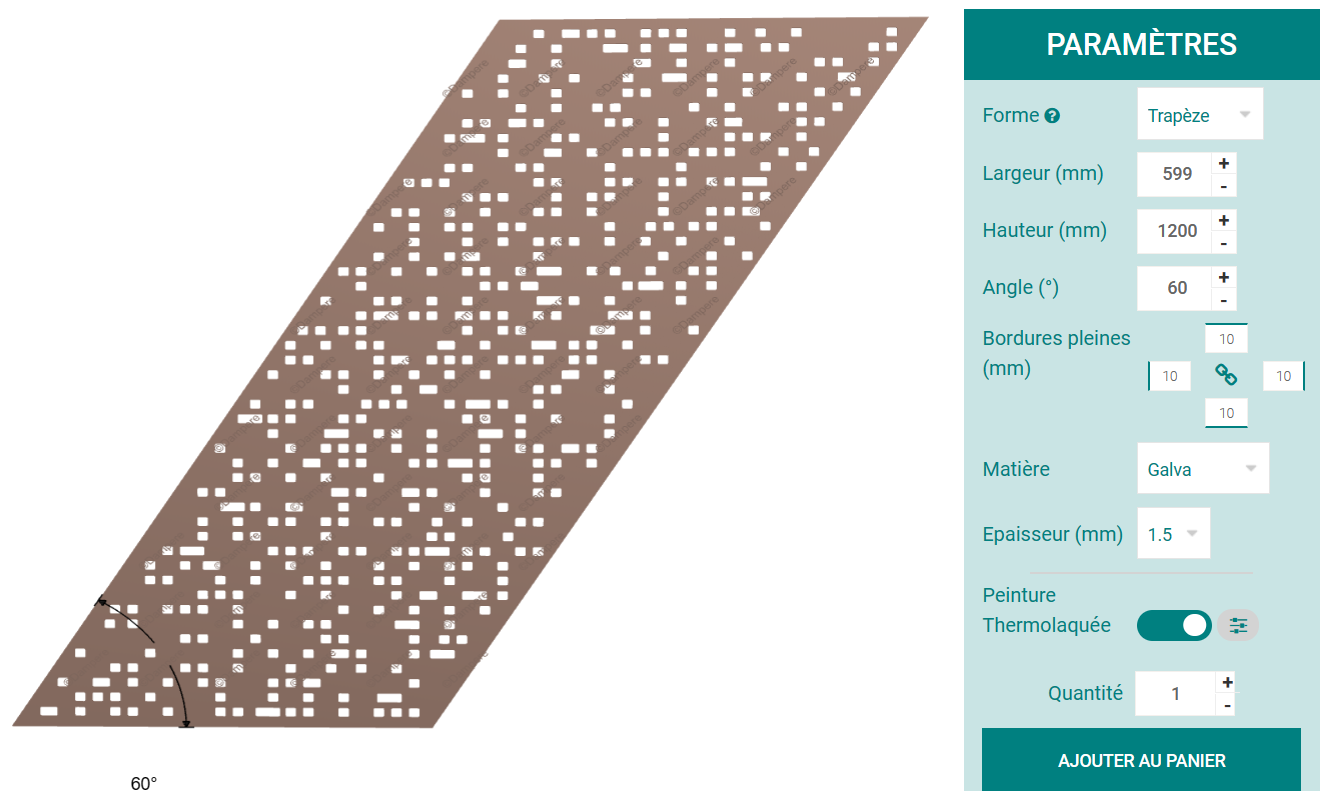
Configure your custom parallelogram online using our graphical interface. The metal parallelogram decorates and protects against falls. All trapezoid angles can be created using the graphical shaping tool for professionals.
The first configuration step allows you to select the dimensions. Starting with three dimensions, you can define any custom parallelogram.
Width and height are the main elements that make up the parallelogram. Added to the angle of inclination, these three values give rise to the unique parallelogram that appears before your eyes in 3D.
It is important to check these dimensions because it is difficult to modify a parallelogram-shaped metal panel once it has been cut to size.
Then choose the materials: Steel | Galvanized | Aluminum, as well as the decorative pattern and color. From the list of designs in the Dampere range, you can create combinations of color and transparency to highlight your parallelogram. The Real-Time 3D Visualization tool allows you to see what your custom parallelogram will look like. Rotate and zoom in to inspect the details. The dimensions are repeated on the drawing. You can save your basket with the custom parallelogram configuration and then check the dimensions before placing your order and starting production.
Customer Service provides you with access to online support for any questions or assistance you may require during setup.
Why a custom-made parallelogram?
Because there is no such thing as a standard parallelogram, parallelograms must be custom-made to suit the specific conditions of the construction site. Trapezoidal shapes have a variety of interesting and attractive applications in interior design and architecture, each with different dimensions.
Parallelograms can be used to fill in a slope in the ground, either on a fence, a facade with a sloping sidewalk, in an emergency staircase, and even on house walls when the contours are not rectangular.
There is also an architectural concept of the parallelogram that can be found in various installations, in which the parallelogram serves a decorative function to attract the eye or add dynamism to the building.
- In architectural facades and exterior cladding, parallelogram-shaped panels are often used to add a dynamic and modern dimension to building facades. Their unique shape allows for the creation of interesting geometric patterns that catch the eye of passersby on the street.
- Metal ceilings and suspended ceilings in trapezoidal shapes can be used in commercial or residential spaces to introduce unique angles and perspectives.
- Trapezoidal acoustic panels used in auditoriums, offices, or conference rooms can help improve acoustics while adding a touch of style.
- Bar counters or kitchen islands shaped like parallelograms add visual interest and can improve the functionality of the space.
- Parallelogram-shaped partitions can be used to divide spaces while allowing light and air to circulate. They are particularly popular in open-plan offices and coworking spaces.
- Trapezoidal wall panels can create dynamic, modernist patterns, adding character to a room.
- Metal wall decorations in the shape of parallelograms, often cut with precision, can represent artistic patterns and add interesting texture to a wall.
- Bridges and engineering structures are designed with trapezoidal elements, such as piers or supports, adding a dimension of strength and gradual rise, creating an impression of continuous movement.
- Staircases with parallelogram-shaped steps can offer a unique and modern look while maximizing space.
- Parallelogram-shaped windows add a distinctive architectural touch and can help create interesting light effects.
- Terraces and pergolas using trapezoidal elements can offer a modern, geometric aesthetic while delineating spaces in an original way.
The parallelogram indicates a direction in your decoration.
Indeed, the word "parallelogram" often evokes a specific direction or inclination due to its characteristic shape. In different contexts, the parallelogram can be associated with different notions of direction or movement. The geometric definition reminds us that a parallelogram is a quadrilateral with at least one side parallel to another side. This characteristic gives the parallelogram a particular direction, often represented by the angles of its sides.
Symbolically, the metal parallelogram can evoke ideas of movement, dynamism, or direction. Its slanted shape may suggest progression toward a focal point or specific goal.
In design and decoration, metal parallelograms can be used to create an illusion of movement or to direct the eye in a particular direction. The strategic placement of trapezoidal shapes can influence the perception of space and circulation within a room.
The parallelogram, a shape with multiple meanings
The parallelogram can have several symbolic meanings depending on the cultural and historical context.
Dynamism and Movement: the parallelogram symbolizes fluidity and grace. It evokes the ability to overcome obstacles and embrace change with agility. But the parallelogram can also represent a transition between two states or two situations. It symbolizes the passage from one point to another, marking a period of transformation or progression. The parallelogram implies a certain degree of risk and daring in the way it is used. On the contrary, the parallelogram can symbolize the importance of finding harmony and balance in life, juggling the different facets of existence, which can provide a feeling of freedom and letting go, leaving behind constraints and inhibitions. The parallelogram symbolizes the ability to break free from limitations and explore new horizons. By extension, the decorative parallelogram represents artistic expression and creativity. It embodies the beauty and elegance of the creative movement in all its splendor.
Finally, the parallelogram represents collaboration and trust between two people. Mutual trust and collaboration are essential to successfully bring two parallelograms together. The parallelogram therefore also symbolizes the need to work together and support one another in order to succeed.
For all these reasons, the parallelogram is often used in architecture and interior design.
The parallelogram offers transition and dynamism in decoration.
Absolutely, the idea that "the parallelogram opens the transition" evokes the idea that this particular geometric shape can serve as a starting point for change or evolution. In geometry, the parallelogram is often used as a transitional element between simpler shapes, such as triangles and quadrilaterals. It represents an intermediate step in the classification of geometric shapes and paves the way for more complex concepts.
In the fields of design and architecture, the parallelogram can be used to mark the transition between different structural or decorative elements. On a more abstract level, the parallelogram can be seen as a catalyst for transition in the creative process. It can inspire new ideas, encourage the exploration of new avenues, and stimulate innovation.
The parallelogram, a special shape par excellence
The parallelogram is a versatile geometric shape that can blend harmoniously with several other shapes depending on the context and design objective. Wherever a parallelogram is placed, it resonates with other elements or blends its contours with the surrounding elements:
Parallelograms and rectangles often form an effective duo in many designs. Their combination creates an interesting contrast between straight lines and slanted angles, adding dynamism and balance to a composition.
Similarly, squares and parallelograms can complement each other, creating a contrast between the right angles of the square and the slanted angles of the parallelogram. This combination can give a design a modern, avant-garde look.
Triangles and parallelograms can be combined to create dynamic and expressive geometric compositions. This combination allows you to play with angles and proportions to achieve striking visual effects.
The custom-made arch shape can be used to soften the angles of the parallelogram and add a touch of softness to a design. This combination can be particularly effective in creating an organic and fluid aesthetic.
Although circles and parallelograms appear to be opposing shapes, combining them can create unique and surprising designs. The curves of a circular wall decoration can soften the angles of the parallelogram, creating an interesting contrast between straight and curved lines.
The parallelogram in staircase production and protection
The parallelogram of a staircase refers to the geometric shape of the steps used to construct the staircase. Specifically, the parallelogram of a staircase is defined by the characteristics of a four-sided geometric shape with two parallel sides. In the case of a staircase, the parallel sides correspond to the width of the step, while the non-parallel sides are sloped to form the incline of the staircase. The dimensions of the parallelogram of a staircase include the length of the parallel sides, the length of the non-parallel sides, and the height of the step. These dimensions determine the slope of the staircase as well as the size and comfort of the steps. The inclination of the parallelogram of a staircase refers to the angle formed by the non-parallel sides of each step. This inclination is generally determined based on safety, ergonomic, and aesthetic considerations for the trapezoid.
The design of a staircase's parallelogram can vary depending on architectural style, aesthetic preferences, and space constraints. Some staircases may have uniform, regular parallelograms, while others may feature variations in step dimensions and angles to create interesting visual effects. It is also possible to curve a parallelogram to match the helical curvature of a spiral staircase.
Fencing on sloping ground, an innovation from Parallélogramme
Using parallelogram-shaped privacy fences to adapt to sloping terrain is a practical and attractive solution for demarcating urban spaces while following the natural contours of the sloping ground. Parallelogram-shaped metal fences are an elegant and effective solution for sloping terrain. By following the steps of planning, measuring, and installing, you can create a custom fence that not only follows the slope of the terrain but is also stable and attractive. This approach allows you to maintain a uniform fence height while harmoniously adapting to the natural contours of the terrain. An innovative solution offered by DAMPERE.
Custom-made parallelogram-shaped fence panels, where the parallel sides remain equal but sloped, allow you to follow the slope of the terrain while maintaining a uniform fence height. By choosing metal, you are opting for durable materials that are suitable for outdoor use and resistant to the elements. To assess the slope of the land, measure the incline and identify the sections where the slope varies the most. Then divide the metal fence into modular sections 850 mm to 900 mm long that can be adjusted according to the slope. Make sure that the spacing between the posts remains uniform despite the slope. This will help maintain a consistent appearance. Each section will be a parallelogram corresponding to a specific part of the slope. You can then install the posts so that they are perpendicular to the sloping ground. This means that the support posts themselves will not be vertical, but sloped to match the slope of the terrain to fit the contours of the parallelogram. Ensure that the metal posts are firmly anchored in the ground, using post supports and concrete if necessary, to prevent them from moving or sinking. Attach the parallelogram fence panels between the posts. The panels should be adjusted so that their edges follow the line of the slope.
Limits of custom-made metal parallelograms
- Parallelogram at an affordable price
Producing a metal parallelogram can be costly due to the metal scraps that result from the cutting process. There is always a triangle or trapezoid left over from the initial format, which must then be recycled for another purpose.
If your project consists of several metal parallelograms and trapezoids, it is possible to optimize the cutting process. The metal scraps resulting from cutting the parallelograms can be reused for other projects. For example, small pieces can be used for decorations, reinforcements, or supports. We can transform metal scraps into decorative or functional accessories, such as plant holders, hooks, or design elements, adding value while reducing waste.
The economical solution remains simple geometric shapes, such as rectangles or squares, which generate less waste when cutting. Simple shapes are easier and less expensive to produce. Similarly, if you use standardized modular panels, they can be better adjusted to suit the project.
- Fragile transport risk
Indeed, transporting parallelogram-shaped metal panels can pose specific challenges, particularly with regard to the fragility of the corners.
Additional packaging may be charged to better protect the parts:
– Reinforced corners to wrap around the corners of the parallelograms. This protects the corners from impact and abrasion during transport.
– Pallets and wooden crates specially designed to hold the panels in place and prevent them from moving during transport.
Training staff on site in handling techniques ensures that the appropriate techniques are used to handle and transport metal panels safely. Under these conditions, appropriate handling equipment, such as forklifts with padded forks, must be used to avoid damaging the panels during loading and unloading, and the panels must be inspected regularly during transport to detect and correct any problems before they cause further damage.
- Risk related to the dimensions of the parallelogram
It is important to choose the correct size, as it is impossible to recut the piece once it has been custom-made. When designing and producing parallelogram-shaped metal panels, understanding the maximum format can often be misinterpreted due to neglecting the tips. The tips of parallelograms add extra dimensions that must be taken into account to avoid measurement errors and complications during manufacturing, transport, and installation.
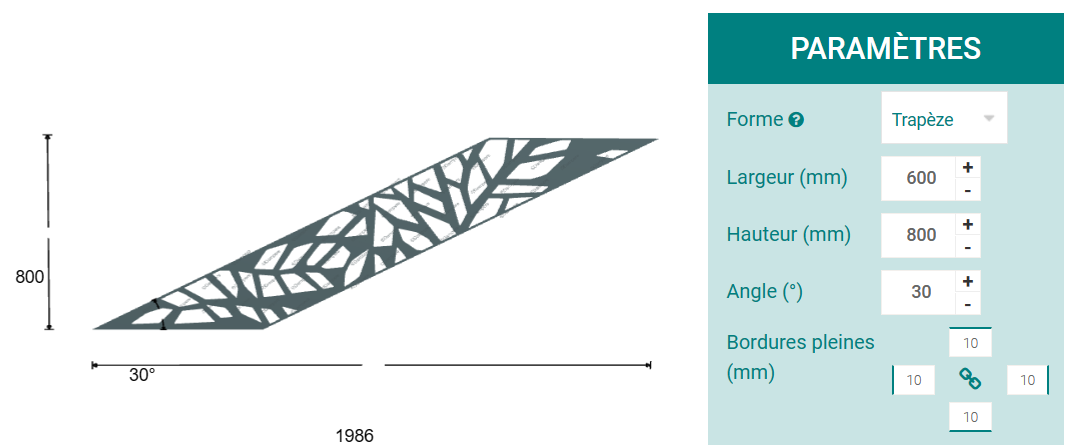
It is possible to reduce the risks associated with parallelograms. With a little care, you can achieve the shape you want for your project by ensuring that you interpret the dimensions correctly. In the custom parallelogram configurator, always check the total dimensions of the parallelogram, including the length of the sides and the height. This includes measuring the furthest point to ensure a complete understanding of the panel dimensions, as indicated in the module control plan. The diagrams are clearly annotated to avoid any confusion.
In addition, safety margins should also be added to ensure the project is installed correctly. When considering the shape of the metal panels, safety margins should be added to avoid errors and damage. These margins can be positive or negative tolerances, allowing for minor adjustments after installation. It is therefore necessary to consider whether to cut the panels slightly smaller or slightly larger than required. Depending on the configuration of the site, this adjustment can make the difference between a successful or unsuccessful installation.
Before manufacturing, validate the designs to ensure that all dimensions are correct and that the specific characteristics of angles and points have been taken into account.
